Thursday's Columns
April 30, 2026

Stealing Beauty
by
Mark Lehnertz
Denver
Confluence
Writers
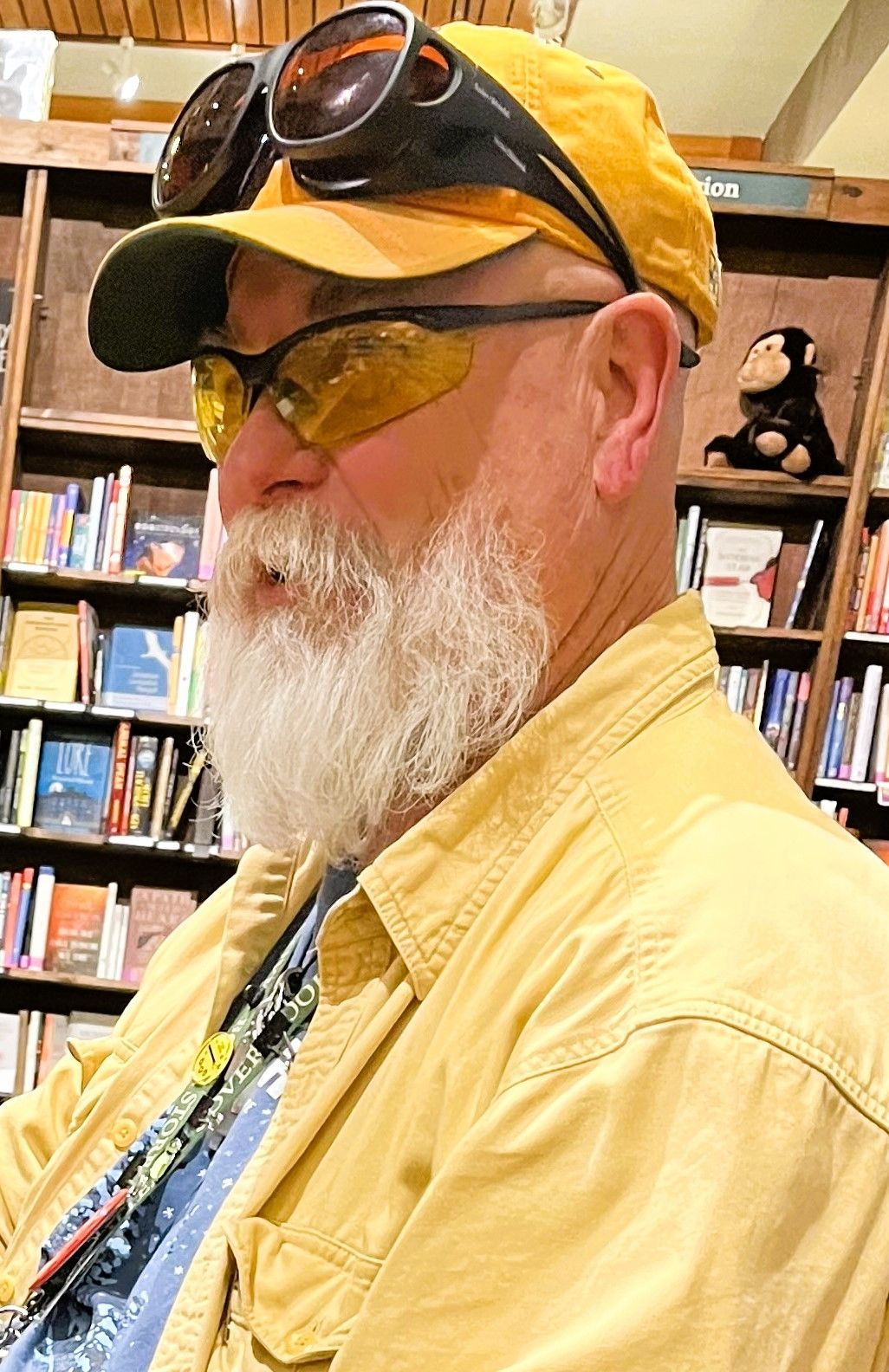
Mark Lehnertz
Thou shalt not steal! Oft repeated and usually delivered in an imperative mood, but surely there are exceptions.
This thought arises a short while after dawn, while staring across smooth water. The kayak paddle is momentarily still, held above and beside the boat. Drops falling from one blade catch brief glints of sunlight, then disappear into the water. The aching beauty of the scenery strikes without warning, nearly robbing breath.
A sigh, then the understanding that in this place, at this moment, to see and feel this is to be stealing beauty. The exuberance of spring is greening the foothills, the air is clear all the way down the hogback to the red rocks of the Morrison formation—a part of Roxborough.
Birdsong, the almost rain-scent rising, and broken clouds turning from a flat gray scrum above the Rockies to white puff balls as they drop in altitude to move out over the rolling, high plains, glowing in the sunlight.
Bless me reader for I have sinned, I have stolen beauty in this moment.
It becomes almost a riddle, asking: What can be stolen, yet remain where it is?
To truly attend to paddling a kayak is to feel every motion of the dynamic balance… thoughts falling into stillness, illusion of self, of identity. Patterns of patterns of patterns of waves and particles of energy and matter flowing everywhere with and against and into one another without a need to be defined.
With each push and dip and rise of the paddle there is no need for thought or illusion, just the awareness of breath. The quiet slap of the paddle blade and the shushing draw of water chasing after the pull, with its two counter rotating eddies pulling down from the surface for the mere moments they last. Each a hurricane for the micro-life, bare dimples for the paddler.
And yet more beauty, mated mergansers, on a stump and a log, closer at hand to sweep away and steal in this moment. Ahead and to the right my wife, paused in her kayak, eyes the scene through the lens of a camera, capturing a composed image to be shown later — the serenity expressed with each movement, every second, every frame until the camera is tucked away and the paddle put back to use. The boat pivots even as the mated mergansers hop off of their respective stump and log to swim away, a slightest turn of their stately heads betraying their minimal attention.
Spring. The screen of birdsong bends and billows and swells, a storm of sound. Where are they? Perched and flitting, an individual sparrow, or chickadee, or black bird here or there, but so much song from all around. The arrangement an accident of each, that together in the all becomes this improvisation too delicate for a composer. Too urgent for an orchestra. Maybe only the jazz sensibility can capture the dynamic, each bird a master…Lady Day, Dizzy, Miles, Sarah, Herbie Mann.
Spring. The shoreline, bare just two weeks ago, its millennia-old flood-surge rubble of tumble-polished sand and rock and gravel now showing flashes of green pushing up after sunlight. Is green-blush a term? It begins to tint and shade the browns of soil and sand. It’s coming, the hallelujah chorus of plant life arising to reach for the sky waving its collective worship.
Coming down a slope nearly hidden behind last year’s willows, a fly-fisherman anticipates the spring gathering of trout.
Barely five paddles and the scene is left behind in the search for current as the main channel of the Platte River is somewhere near, flowing, motion… How can we steal what's there to be possessed, just for the asking, free of charge?
--30--
Our
Story
by
Lawrence Abby Gauthier
ace reporter
The Westphalia Periodic News
What is beauty?
I’ve been reading Behrooz Ghamari’s book “The Long War on Iran” where I came across a passage that got me to thinking about beauty.
“Legend has it,” Ghamari wrote, “that in 1972, when Chinese Premier Zhou Enlai was asked about the impact of the French Revolution, he replied that ‘it’s too soon to say.’”
I put the book down to ponder the French Revolution… Lafayette’s allies storming the Bastille in the name of Liberty, Equality, Fraternity. Such beautiful words, beautiful ideas, so beautiful. The 19th century French writer Stendahl wrote that beauty was the promise of happiness.
When I was an over-the-road trucker, people would ask me what I thought was the most beautiful place, or thing I’d seen during my travels to everywhere on the highways of American road lore.
I had seen o’ beautiful for spacious skies and amber waves of grain; the Columbia River Gorge; the sun going behind snow-capped mountain peaks; the foam of an ocean crashing up against the Oregon coast.
“An old rusted trash barrel,” I’d say.
“A trash barrel?”
“Yeah, a trash barrel. It looked like it had once been a 55-gallon oil drum with an axle and wheels bolted to its bottom and handles welded to its side. It was set out on the curb of a Main Street in a small town waiting for the garbage truck to arrive in the morning to take its contents away.”
It was around 2 a.m. when I saw it — the trash barrel. I was hauling 20 tons of dog food from southern Georgia going to a Pet-Smart warehouse in Salt Lake City when it caught my eye.
I had four days to get to Utah. No problem. No rush.
I liked to sleep during the day and drive at night when traffic was light and I could exit the Interstate to take two-lane backroads through peopled towns without losing too much time.
I was somewhere in southern Mississippi. The black sky sprinkled with specks of light, the moon a silvery sliver. The mighty Detroit diesel engine beneath the hood of my truck purring like a kitten. Headlights pointing the way. The sound of 18-wheels rolling over pavement. Keep it between the lines and everything will be all right.
Passing through a swampy area, I saw ghosts. A man and a woman were fleeing from their lives as slaves to the owner of the local plantation, up to their knees in the mucky waters of the swamp where it would be hard for the dogs to pick up their scent.
It was unnerving. I shook my head. I don’t believe in ghosts, at least not the kind that look the way you see in movies — glowing white shrouds.
A few miles further on up the road I came to a small town. At the edge of town was a Colonial-style mansion, like something out of Gone with the Wind, where once upon a time the owners of the slaves had lived.
It was a museum now.
Main Street was maybe five blocks long, a street light, a bank, a pawn shop, a café/pool hall/bus depot, things like that. It could have been the town of Mayberry, as in the Andy Griffith Show, or the small town where I grew up in America in the 50s. A cover on the Saturday Evening Post. A place where people followed the rules without too much complaining.
2 a.m.
I crept along. The speed limit was 25, strictly enforced. I kept it under 20. Instinctively, my eyes searched around for the standard small town cop itching to catch an out-of-town trucker doing 27. But nothing. Nobody. Not a speck of human life. Empty. Motionless. Even the traffic light remained yellow, unchanging. There was only me, like the character in that post-apocalyptic scene from the Twilight Zone when he first realizes the that he’s the only one left. Only me in a universe that keeps expanding making me smaller until I’m less than a point… creating it all. Alone. Nobody to talk to. Nobody to listen.
First ghosts and now this… this feeling of utter aloneness. I could feel a tightening in my chest. A quickening of breath. Like a paranoia like the first time I smoked a joint and suddenly realized that I was alone in a crowded room.
That’s when I noticed the trash barrel set out next to the curb and I could release my breath. Others would be coming to empty it in the morning. They'd soon be on their way. I wasn’t alone. Damned if it wasn’t the most beautiful sight I’d ever seen.