Thursday's Columns
November 26, 2026
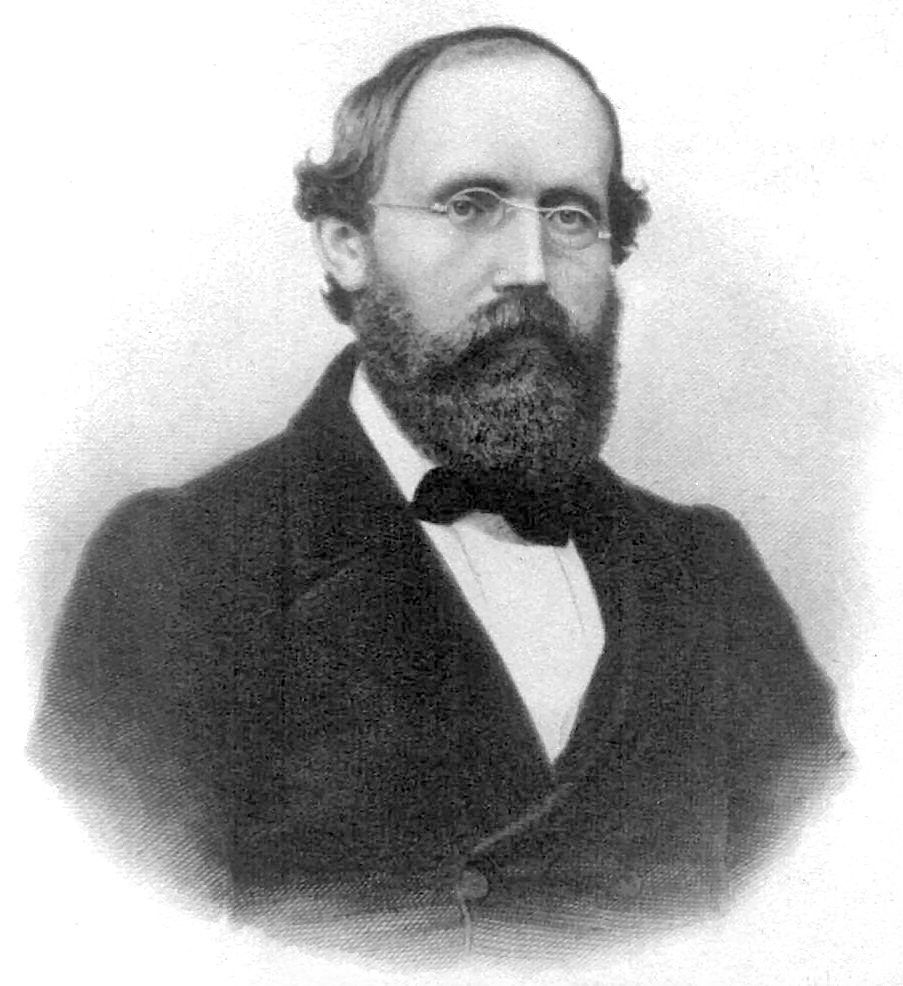
Bernard Riemann
Our
Story
by
Lawrence Abby Gauthier
ace reporter
The Westphalia Periodic News
A headline in Scientific American this past week caught my attention:
ANTHROPIC MATHEMATICIAN PROVES
RIEMANN HYPOTHESIS:
Most Famous Problem in all of Math
The story made it into the New Times as well and is popping up all over social media. According to AI — the new AP — “Bernard Riemann’s mathematics reshaped how scientists and thinkers model ‘different realities.’”
So it’s true… there are “different realities.” It’s not just a 70s LSD dream. Millions of lines of AI code just proved it.
I first heard about Riemann in the late 70s. I was a reporter in Detroit at the time, working on a series of stories about the quest for fusion. When I learned that relevant works of an obscure 19th-century German mathematician was being classified top secret, my interest was piqued.
Georg Friedrich Bernard Riemann (1826-1866).
A character based on Riemann makes an appearance in a chapter of my will-it-ever-be-finished novel.
In real life, Riemann’s teacher was the German mathematician Peter Gustav Lejeune Dirichlet (1805-1859), who was married to Rebecka Mendelssohn (1811-1858), who was the granddaughter of Moses Mendelssohn (1729-1786).
In Jewish “Reform” circles, Moses Mendelssohn is referred to as “the Third Moses,” after the Moses of the Bible (? - ?) and the famous Sephardic Talmud scholar Moses ben Maimon (1138-1204).
Moses Mendelssohn is known as “the Father of the Jewish ‘Haskalah,” or Enlightenment. As a frail, hunchbacked youth, he walked away from the cloistered life of his home in a poor German shtetl to join the world, entering Berlin through the Rosenthaler Gate, the one entrance into the city reserved for Jews and swine. That night, he slept in a barn on sacks of animal feed. From there, he rose into the circles of the giants of 18th century science and philosophy. He defeated Voltaire and Kant in a famous literary contest sponsored by the University of Berlin. He was read and discussed by members of Franklin’s secret Junto in the years leading up to the American Revolution. He remained an observant Jew, but was no longer a wandering, homeless Jew. He was a “German” Jew. At home in the world.
When he was old, the Third Moses wrote that the “guiding light” of his life had been the 17th century German philosopher Wilhelm Gottried Leibniz (1646-1714) who said that there was no such thing as empty space.
Many families have a secret that’s shared from one generation to the next. The Mendelssohns passed on a question — if there’s no such thing as empty space, what is it?
The granddaughter of the Third Moses passed the question on to her husband, Dirichlet, who passed it on to his prized student, Bernard Riemann.
In the chapter in my will-it-ever-be-finished novel where I introduce a fictional character based on Riemann, we find him at his desk with a notebook filling empty space with different realities, wondering if the world will ever discover how he does it.
--30--
Letters to the Editor
Dear Westphalia:
Last week’s “Our Story” column by Lawrence Abby Gauthier (in Archives, 11-19-26) stayed with me long after I finished reading it. On the surface it begins with a grounded fleet of airplanes and an unexpectedly silent sky, but what lingered for me was the thread of human connection woven throughout the essay.
I found myself thinking about the meal shared at the center of the story. The pork loin from Iowa, the asparagus from California, the sweet potatoes from Mississippi, even the Belgian beer, all serve as reminders that our lives are made possible by countless people we will never meet. What Henry Carey called "association" is not an abstract economic theory here. It becomes visible on the dinner plate.
The image of the cats, alert though their eyes remained closed, felt symbolic of the entire essay. We move through our lives often unaware of the extraordinary networks around us, yet they are always present, quietly supporting us.
The mention of the empty sky also brought back memories of another silent sky after September 11, 2001. I remember the eerie absence of airplanes and the unsettling feeling that something fundamental had changed. I remember gathering with friends for a meal while we sat glued to the television watching events unfold. Our three-year-old daughter innocently announced to our guests that the news had become my new favorite show. Her comment was both heartbreaking and clarifying. In that moment, I realized how fortunate she was to experience fear through a television screen when so many children around the world live daily with war, violence, and uncertainty.
What I admire most about this essay is the way it reminds us that we are connected to one another, whether we recognize it or not. Through food, commerce, friendship, family, poetry, and shared experience, our lives intersect in ways both large and small. Even understanding a poem, as Williams suggested, requires us to participate in that act of connection.
Like the poems Williams admired, "Our Story" is accessible while offering deeper rewards to attentive readers. It is a thoughtful meditation on community, dependence, and the invisible ties that bind us together.
Anna Kanski
Denver, CO