Thursday's Columns
November 12, 2026
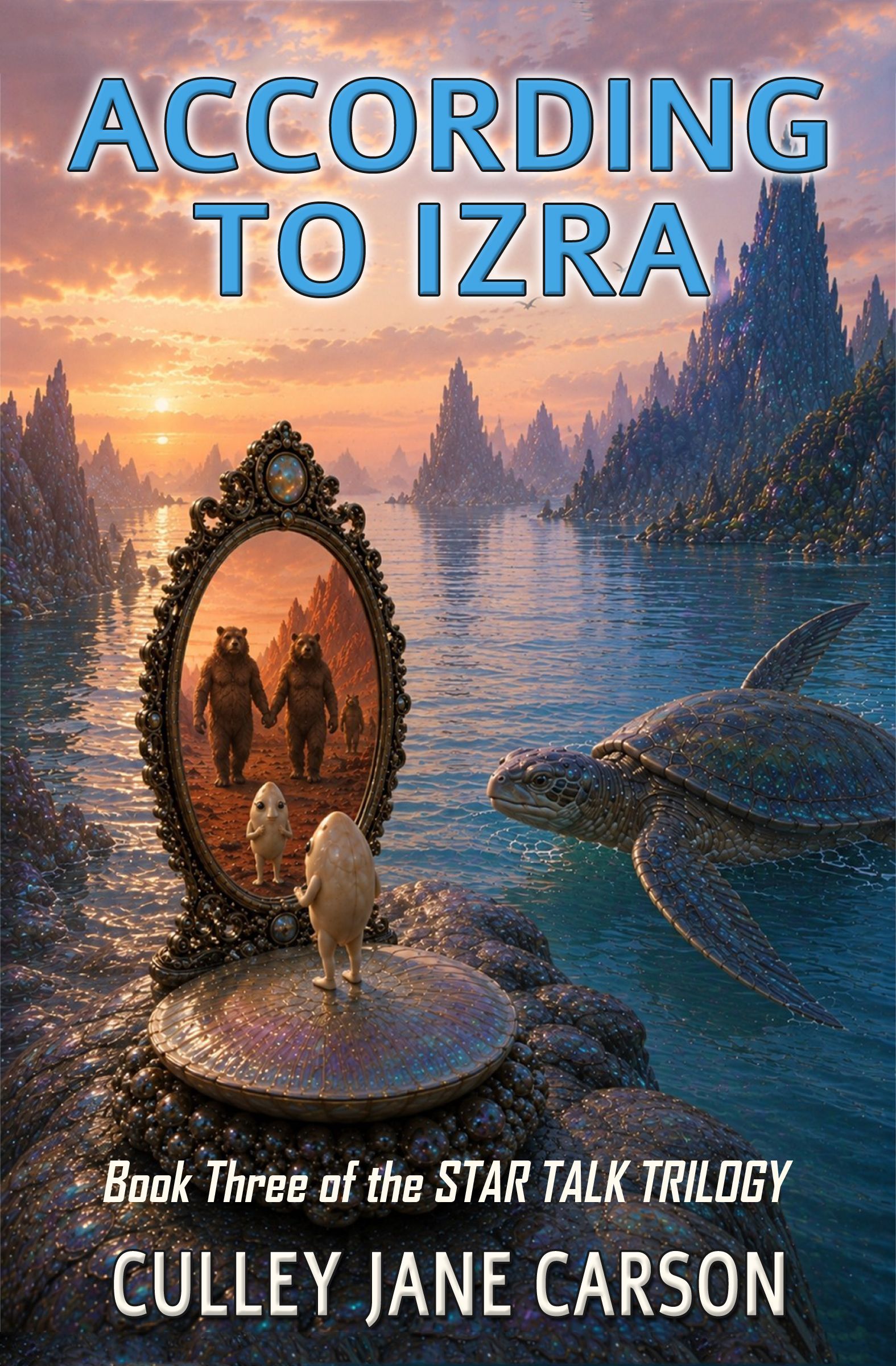
Now Available on Amazon
An almond-shaped creature brings peace
to the Intergalactic Federation.
Literature for all ages, 14 to 94.
Paperback: $12.95
Kindle: 4.95
--30--
Our
Story
by
Lawrence Abby Gauthier
ace reporter
The Westphalia Periodic News
The first chapter of my will-it-ever-be-finished novel is called “The End.”
Endings come to me first. Once I know where the journey ends, the rest is just a matter of pulling my boots up in the morning and going off to work, doing what I know how to do to get there.
Culley Jane and I were settled into our spots on the living room couch in front of the television, one cat on her lap and one cat on mine. We hardly ever watch television, but this night was special — Election Night. We were anxious to know how it would end.
I had the remote clicker and suddenly the NBC newsroom appeared in bright AI color and just as suddenly my mind began to wander... I was back in my truck during my over-the-road trucker days.
I had just come to the end of a cross-country trip hauling a load of California almonds from the San Joaquin Valley to a warehouse in a sprawling shipping port along the Atlantic coast of New Jersey when it struck me. It was so obvious it was laughable. How come I’d never noticed it before, that endings come to me first and then you just go to work?
Once the Teamster dockworkers had finished unloading my 53-foot trailer and had signed the delivery papers, I sent a Qualcom message back to my dispatch office in Lincoln, Nebraska, letting them know I was empty and ready for my next assignment.
Then I pulled away from the docks and parked in a sprawling paved lot the size of a football field with dozens of other trucks from everywhere in America. A little off in the distance, beyond the warehouses, I could see giant transoceanic freighters exchanging almonds for Belgium beer.
And I waited while waiting to hear back from dispatch in Nebraska assigning me to my next load, where to pick up, where to deliver, date/times — the information I needed before making my next move. And that’s when it struck me, while waiting for an answer, that endings come to me first. Until I knew the ending, I was lost, stranded in New Jersey and didn’t know what to do.
I imagined myself as an electron. As it journeys across a Silicon microchip no bigger that the point of a pin, an electron encounters billions of intersections where it has to decide. Unless it knows where it’s going, when it gets to the first intersection it won’t know whether to turn left or to turn right. Just leaving it up to feelings, it goes in circles before winding up in the ocean.
I felt the cat move and was suddenly back in the NBC Election Night newsroom. It didn’t take long to know the ending so that we could make our next move. Prepare for a window of peace so we don’t find ourselves back in the same hole.
--30--
Barbarity
by
Dr. Patrick Henry
Walla Walla, WA
The announcement that the execution of former Army psychiatrist, Nidal Hasan, would be televised prompted immediate blowback from Republicans and Democrats, who considered televising the execution barbaric.
But, as French novelist Albert Camus argues in his 1957 "Reflections on the Guillotine,” if the state considers the death penalty a deterrent, it should invite as many people as possible to the execution and televise it for all those unable to attend.
Bob Dylan himself wonders why "The executioner's face is always well hidden."
It is the execution itself that's barbaric. Not simply this one, a firing squad gunning down a man in a wheelchair, or the recent botched execution of Christa Pike, but all executions, which are as repulsive as the crimes they purport to punish.
Furthermore, capital punishment is not a deterrent. Camus notes that, as of 1957, 35 nations had abolished the death penalty; none reported an increase in crime.
We do not underscore the sacredness of life or the principle that no one has the right to take the life of another by killing those who do so. We need laws of ethical integrity that do not contradict their principles when they punish their transgressors.
--30--
Intersection
by
Tina Russell
Iron Mountain, MI
Tumbling thoughts are chaotic, fleeting
Deep inside a painful guttural cry
Lost in a swirl of what was
and what could have been
A soul ripped apart
by violence and neglect
Wanting to slam doors
Wanting to burn the bridges
Walk away and it hurts no more
There she stands at an intersection
Time flies forward by decades and years
Months and days and years combine
Many lifetimes lived
in small moments of time
None of them build anything real
Life lived running from the past
No room for mistakes
but that’s all she makes
Confusion reigns
There she stands at an intersection
Looking back one more time
At pain, at death, and at humiliation
Glancing back at the bruises and scars
of her past
Tuning out words that made her small
Smiles at old ghosts & demons
that can’t hurt her anymore
The bridge is old and dry now,
it’s lost its power
She lights the match
and sets fire to the past
There she stands at an intersection.
--30--
Letters to the Editor
Dear Westphalia:
Thank you for sharing Matthew Wollum's story, "Once or Twice." (In Archives, 11-5-26)
Matthew's pieces often feel like stepping through a looking glass. They begin in whimsy, wander through absurdity, and somehow arrive at truth. This story amused me from the first line, but what lingered was its tenderness. Behind the playful role reversal is a gentle meditation on partnership, forgiveness, and the enduring hope that love will welcome us home, even after we have behaved badly.
The best writing entertains and enlightens simultaneously. Matthew does both. I was smiling at the humor while quietly recognizing myself in the man standing at the back door, waiting for grace.
Anna Kanski
Denver, CO