Thursday's Columns
March 26, 2026
Our
Story
by
Lawrence Abby Gauthier
ace reporter
The Westphalia Periodic News
Donald. Donald. It’s ok. It’s not a personal defeat. You can step back from the scary dream. Lao Tzu tells us there’s victory in retreat.
Donald. Donald. Open the other door. You can put down your stones. Take the day off. Do something nice for yourself.
I’m not talking about the golf course at Mar-a-Lago with its manicured greens and traps and everybody’s keeping score.
Find yourself a forest of interwoven leaves and mountain streams to bathe in naked stripped of the robes that confine and hide you.
Start a campfire with the Wall Street Journal. Read Terry Irwin’s story in this week’s issue of the Westphalia Periodic News. Feel the breath of the world washing through you. A sigh of relief. Victory in retreat!
--30--
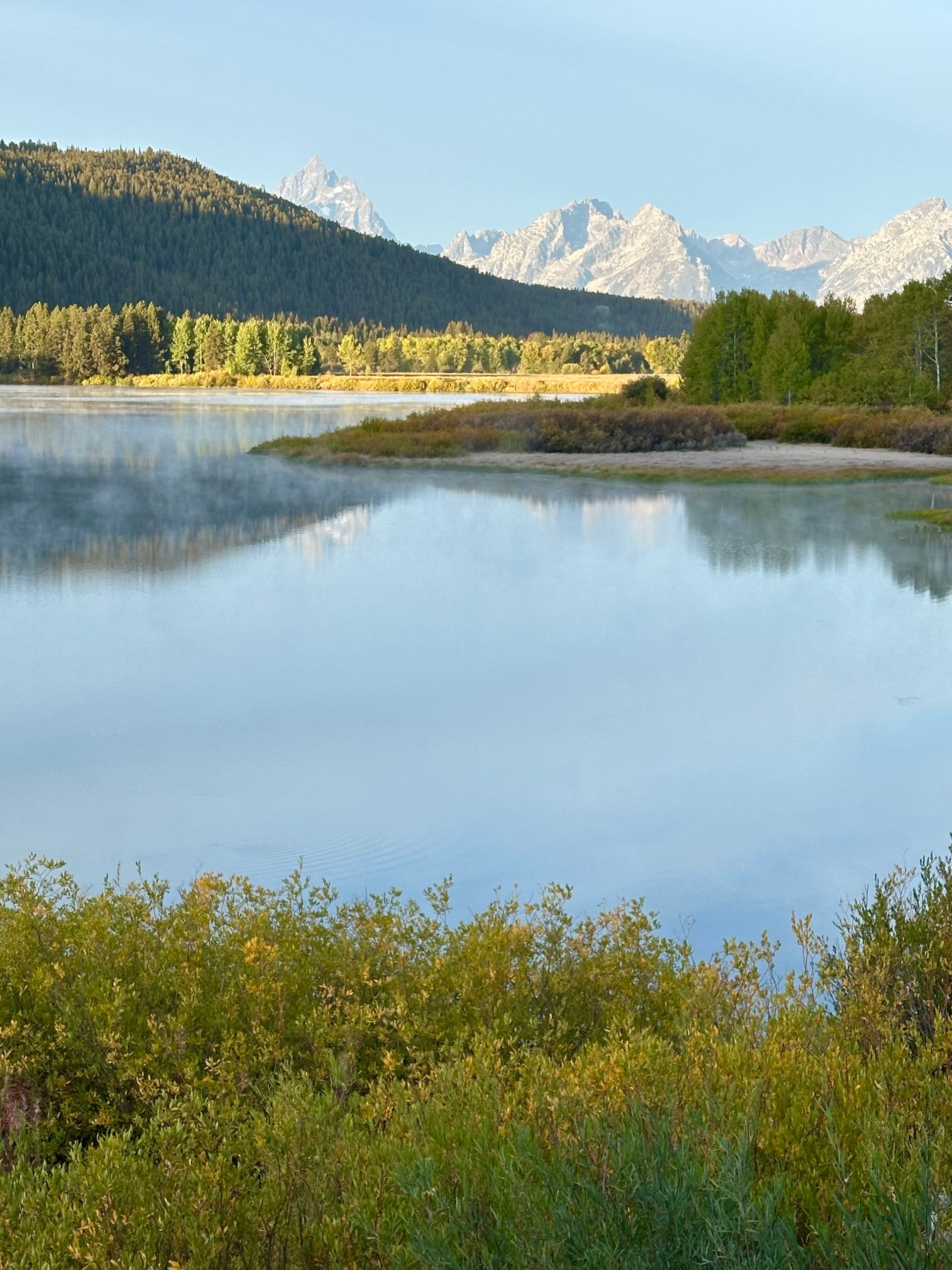
Oxbow Bend photographed by Terry Irwin
Gum-Smackers
in the Wilderness
by
Terry Irwin
Denver Confluence Writers
For as much time as I’ve spent in both Yellowstone and Grand Teton National Parks, a mammal I haven’t seen in years is proving pretty elusive. It’s not that I've never seen one. I did, once, years ago, on the north shore of Yellowstone Lake, but I am beginning to give up hope that I will ever see one again. I even ask for suggestions from a seasonal ranger who tells me in his twelve years working in the park, he’s never seen one, which, okay, makes me feel the tiniest bit better.
But now, I am standing on a tangled hillside, four feet above the Snake River admiring the black, Double-Crested Cormorants on a distant sandbar at Oxbow Bend in Grand Teton National Park. Having positioned myself at an isolated spot, I am a bit miffed to hear someone nearby break the silence with truly the loudest gum smacking sound I’ve ever heard.
Yet, looking around, I see there is no such offender. Below on the river, however, are the concentric waves from something that has ducked back into the water. Waiting for the possibility it might resurface, I watch capillary rings continue to widen. The cormorants waddle from the sandbar into the river. A lone Great Blue Heron glides gently over the inlet. Eventually, there’s no trace of any water disturbance here.
I’m quite certain whatever was below me has gone when up pops a North American River Otter, one capable of holding its breath for four minutes. In its shiny paws, it clutches a five-inch fish. The otter tears into it, chews with such open-mouthed gusto that, in our close proximity, I mistook the sound for someone smacking their gum.
Otters range in length from 22” to 32” but it’s hard to determine the size of this one. All I can see is its head bobbing in the center of steel-blue ripples. When it curl-dives, just the shimmery midsection is visible. Finally, the long, narrowing tail which they use to steer appears, accounting for a third of its total body length.
The otter continues to amuse, rolling and swirling beneath the water. It emerges three more times, always with a fish, then peels off in another direction until I can no longer follow its trajectory.
Not even five months later, John and I round the same curve at Oxbow, catching sight of three distinct otters! Already far from shore, we see the direction they seem to be headed, so at the pull- off, we do a U-turn, turning west onto a gravel road. To reach the river’s edge, we traverse on foot, scratching our way through dry, waist-high grasses scattered with purple thistles. John sets up his camera tripod on the sandy ledge as I’m hustling to a lookout, a short distance from the shoreline.
The river is so wide here, it could be mistaken for a lake. The expanse makes it difficult to spot the otters. Equipped with sensitive whiskers, River Otters navigate dark, murky waters for their main fish diet, but also find amphibians and crawfish.
What eventually aids in spotting their dark, half-circle heads on the water, is the brilliant reflection of a hundred golden aspen trees glowing behind them in the sunlight. Their appearance is short. Too soon they are gone altogether, and I can’t find their wakes anywhere.
By now, other people gingerly approach our location along the river, having sacrificed their legs to the itchy thistles. Most of them gather near my big guy with the impressive camera equipment. A woman and man my age stop within whispering distance of me. They ask, so I quietly relate that it’s been six, no, closer to seven minutes since I last saw the otters.
The river now is almost glass-like and still.
For a while everybody waits. Eventually, some in John’s crowd meander back to their vehicles. Another two minutes of silence passes. The man, no longer whispering, says “Let’s go” as he turns and walks away.
The woman looks over to me as I implore her with my eyes to stay. “They were right over there," I say. "I think if you wait a bit longer, you might see them.”
The quandary is written on her face; either follow her husband or take a chance she still might not see them and he’d have been waiting for her. She stays. Now both of us are scanning back and forth across the water, conjuring the otters to appear.
As if by magic it works, because the otters appear swirl-diving merely twenty feet from our shoreline. I’ve never seen wild otters this close. This weasel species sighting is unique because River Otters are solitary creatures, rarely seen in family groups.
Otters often snag larger fish, but instead of bobbing in the water, will carry them to land for better control, which is exactly what this gum-smacking family of two adults and one small pup do contentedly at the shore. The woman and I stand in smiles of solidarity. A few minutes pass and she waves goodbye, still smiling. I like to imagine her joyful face as she shares the otter experience with her husband waiting in their car.