Thursday's Columns
October 1, 2026
Our
Story
by
Lawrence Abby Gauthier
ace reporter
The Westphalia Periodic News
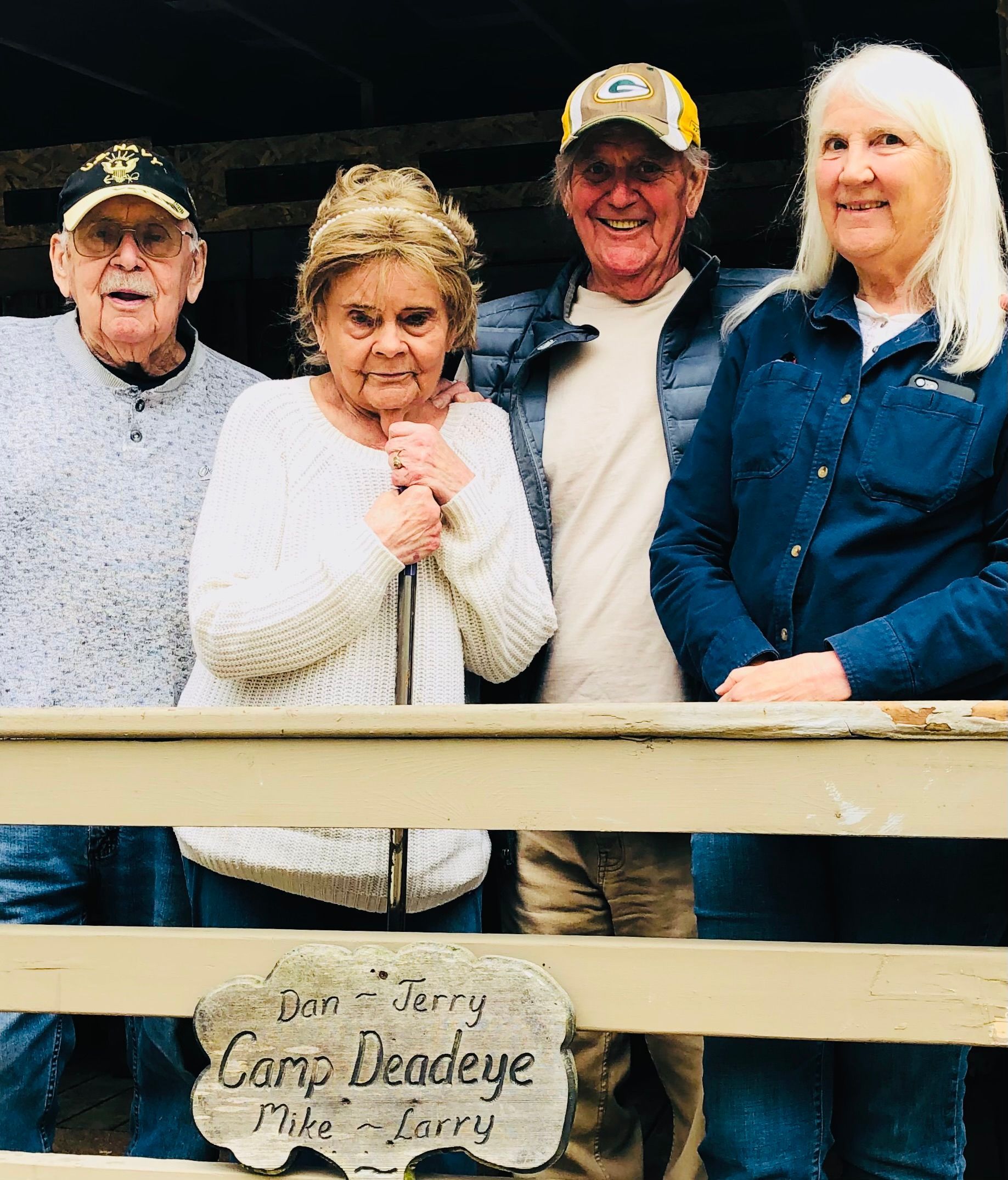
Up at the hunting camp, five years ago.
(from left to right)
Dad, mom, our ace reporter and Culley Jane.
I write about what’s on my mind, not necessarily what everybody’s talking about. At the moment, death is on my mind.
When I write, I try to be grammatically correct. At one time in my life, the New York Times Stylebook was my Bible. At an early age I learned how to diagram a sentence from the Dominicans. From the Beat poets I learned that a sentence can be anything between two periods.
Death is a noun. Dead is an adjective. Die is a verb. To kill is an act, intentional or not.
Life is green. That’s on my mind, too. It’s Fall out here at the western edge of the High Plains. The trees are turning yellow, red and brown. When the earth is on the other side of the sun, the trees will be green again. It’s prophesized.
At the U.N. last week, Trump threatened to kill 91 million people and give every adult in America $5,000 for the right to do it.
“Mowing the grass,” some crazy people say.
Death.
During the past six or seven weeks, my mother died and four weeks later my father died. Culley Jane and I are getting ready to drive up to northern Michigan for dad’s funeral.
Now that the folks have passed, I’ll finally get to see something I’ve always wondered about — what was dad “really” thinking when the earth was on the other side of the sun.
Dad was a writer, although he never tried to publish anything and didn’t share much of it with the rest of us. Kind of his own private world, like on a trout stream.
It’s one of my clearest and most distinct memories of growing up — dad at the kitchen table, in between a bowl of cereal and an ashtray, writing something in a notebook late at night.
He eventually quit smoking, but he never quit writing at night after the day had quieted down.
While he was still alive, he told my sister (who’s in charge of everything) that he wanted me to have his box of writings. He was saying that because I was a writer, too, he wanted me to have them after he was gone.
He had complained about it at first, when I was in high school and announced to everyone that I wanted to become a writer. He hemmed and hawed and grumbled that I should be thinking about something more stable, like a lineman for the power company, or teaching and coaching. Both my brothers were RNs and started companies. My sister has been with the same home medical company for longer than I can remember. They all stayed close to home, Iron Mountain, a hundred miles north of Green Bay. But I became an itinerant writer and I guess dad figured I’d see something he wanted everybody to understand.
When I was up there six months ago as mom was failing faster, he grumbled about not being able to write anymore. Not that the grammatical strings of words were not in his mind, he just couldn’t write them anymore. He had always been proud of his penmanship, the way he signed his name —a controlled, perfectly legible flourish, the way he’d been taught in grade school during the Depression when everything was by hand and by his mother who worked in a law office. But now, he said, he couldn’t make the delicate muscles of his hands and finger do what he wanted them to do; when he tried to write it came out like scribbling, he said, and a keyboard was no help. We got him a Sony tape recorded, but I don’t know if he ever used it. Speaking into a machine and writing it down were not the same. I guess he figured it was something another writer should be able to understand.
So pretty soon we’ll be heading back to Colorado with the box of dad’s writings in the back seat of our pick-up truck and I’ll finally get to see what he was “really” thinking all those late nights after the day had quieted down when the earth was on the other side of the sun.
We’ll see. I’ll take a look. Maybe there’s some really good stuff in there; maybe he could become a regular contributor to Westphalia Publishing’s “Thursday’s Columns.” Maybe he’ll write the novel I’ve never been able to complete. It’s called temporal immortality and he’s leaving it up to me.
--30--
BODIES OF HATRED AND WOMEN OF STRENGTH
by
Dr. Patrick Henry
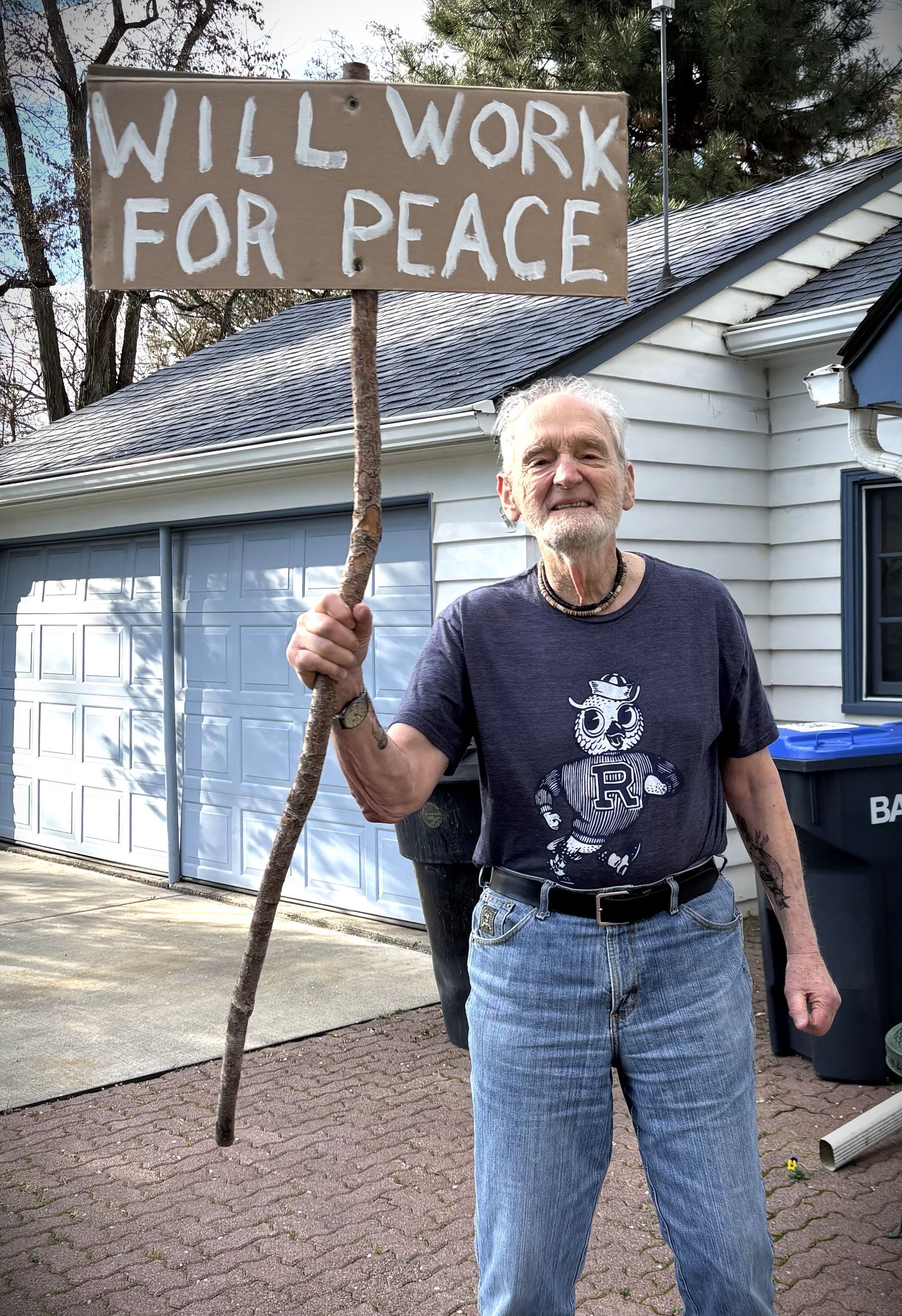
Dr. Patrick Henry; Professor Emeritus
Whitman College
Walla Walla, Washington
The image of Matthew Shepard’s mutilated body haunted me for seven years before I did something about it. On October 6, 1998, the openly gay 21-year-old University of Wyoming student was pistol-whipped until his brain stem had been irreparably damaged and he was left hanging on a rail fence outside of Laramie, Wyoming. He was found 18 hours later and died on October 12th in a hospital in Fort Collins, Colorado.
In 2005, I founded the Matthew Shepard Lecture Series at Whitman College to bring speakers to campus to address hate crimes and issues of equal rights for all people regardless of sexual orientation.
The first speaker invited to campus was Matthew’s mother, Judy Shepard, who was living in Saudi Arabia at the time of the murder. She and her husband, Dennis, arrived in Fort Collins 48 hours after they received the terrible phone call.
In front of a packed auditorium in Cordiner Hall, on March 2, 2005, Judy gave a talk, “The Legacy of Matthew Shepard.”
“Arriving at the hospital,” she said, “I saw a young man covered in blood and bandages. I wasn’t sure this was even Matt.”
She spoke about love, respect, and acceptance of diversity.
“This is a hate thing,” she insisted. “What I do isn’t about Matt anymore. We can’t help him anymore.”
A woman of passion, commitment, and courage in the face of an unspeakable family tragedy, Judy and her husband created the Matthew Shepard Foundation that, 25 years later, still works aggressively to “advance social justice, diversity, awareness, and education for lesbian, gay, bisexual, and transgender (LGBT) people.”
* * *
Another horrific image was also seared into my soul in 1998. Four months before Matthew was brutally murdered, James Byrd, Jr. met an equally dreadful fate. He was murdered by two White Supremacists and another man on June 7, 1998, in Jasper, Texas. He was chained by his ankles and dragged for three miles behind a pickup truck on an asphalt road. He probably remained conscious for half that distance, until his body hit a culvert and his right arm and head were severed. His murderers deposited his torso in front of a black church. He was 49 years old.
James came from a religious family. His mother was a Sunday School teacher and his father a deacon at Greater New Bethel Church. Three of his sisters are Jehovah’s Witnesses.
***
In late 2006, preparing for the Fourth Mathew Shephard Lecture at Whitman College, I called the Byrd family and spoke with James’ sister, Louvon Harris. She said that someone from the family would come to Whitman College to speak. It was Louvon herself who came on Martin Luther King, Jr. Day, January 15, 2007, to give the fourth Matthew Shepard Lecture, “Responding to Hatred: The Byrd Foundation for Racial Healing.”
Before her lecture, Louvon led a candlelight walk to honor Martin Luther King, Jr., and that afternoon, she was part of a panel discussion, “Rejecting Silence: Creative Responses to Hatred.”
In her talk, Louvon spoke about the family’s work to create racial harmony and healing. Members of the Byrd family, that was largely responsible for maintaining peace in Jasper after the killing, campaigned unsuccessfully to spare the lives of the men who killed James.
Twenty years after the murder, a bench was dedicated to James Byrd Jr. at the courthouse in Jasper. At the ceremony, his daughter, Renee Byrd Mullins, said that she wanted to remind the audience that “hate is a learned response.” Louvon was there to express the family’s wish that James’s death “will bring some good.” The inscription on the bench reads:
Be the change that you
want to see in the world.
The Byrd family certainly is the change they want to see in the world.
In large part thanks to Judy Shepard and Louvon Harris, both of whom met with President Barack Obama, the US Congress passed the Matthew Shepard and James Byrd, Jr. Hate Crimes Prevention Act on October 22nd, 2009. This Act expands the 1969 US federal hate-crime law to include crimes motivated by a victim’s actual or perceived gender, sexual orientation, gender identity, or disability.
***
Fifteen years after seeing Louvon Harris off at the local airport, in early November, 2022, I was watching Chinonye Chukwu’s recently released film, Till, about the gruesome murder of Emmet Till and his mother’s courageous journey following the event. As I watched the story of another devastated, powerful, and determined woman refuse to be silent in the face of the brutal death of a family member, I was suddenly overwhelmed with sadness, remembering images of Judy Shepard and Louvon Harris,
As a 15-year-old, I had learned that, on August 28, 1955, 14-year-old Emmett Till had been abducted, tortured and lynched, and had his body sunk into the Tallahatchie River near Money, Mississippi. His body was found three days later. But I knew very few details about what happened afterwards.
The authorities in Mississippi wanted to bury Emmett immediately in Mississippi. But Emmett’s mother, Mamie Till (later Mamie Till-Bradley), called Chicago Mayor, Richard Daley, who halted the burial in Mississippi and had the body shipped to Chicago, as the family wanted.
When Mamie Till saw the mutilated, unrecognizable, bloated body of her son, she knew why the authorities in Mississippi wanted to bury him right away. She also knew why she wanted a public funeral and an open casket: “I want the world to see what they did to my baby,” she said. Emmett’s funeral was held on September 6.
Mamie Till believed her mission was to tell Emmett’s story. Roughly 100,000 people viewed Emmett’s body over four days, and she had the picture of him in his casket published in Jet Magazine. Two days after the September 23 trial in which his killers were acquitted, Mamie spoke before 10,000 people in Harlem. She then went on a month-long trip with the NAACP and spoke in 33 cities in 19 states.
In 1956, Mamie Till-Bradley went to Chicago Teachers College. After her graduation in 1960, she taught until her retirement in 1983.
Mamie added fury to the Civil Rights Movement. Emmett’s funeral was a turning point in the fight for racial justice. His death inspired Rosa Parks, Martin Luther King, Jr., and John Lewis. The Emmett Till Anti-Lynching Act (which makes lynching a federal hate crime) was signed into law on March 29, 2022, by President Joe Biden.
The courage of these three women has inspired thousands of people to reflect and make significant, humanitarian laws that protect minorities from acts of hatred and discrimination. These women teach us that one determined individual can still have a significant impact on the community. They are models for us as we move forward in the struggle against homophobia, transphobia and racism.