Thursday's Columns
March 19, 2026
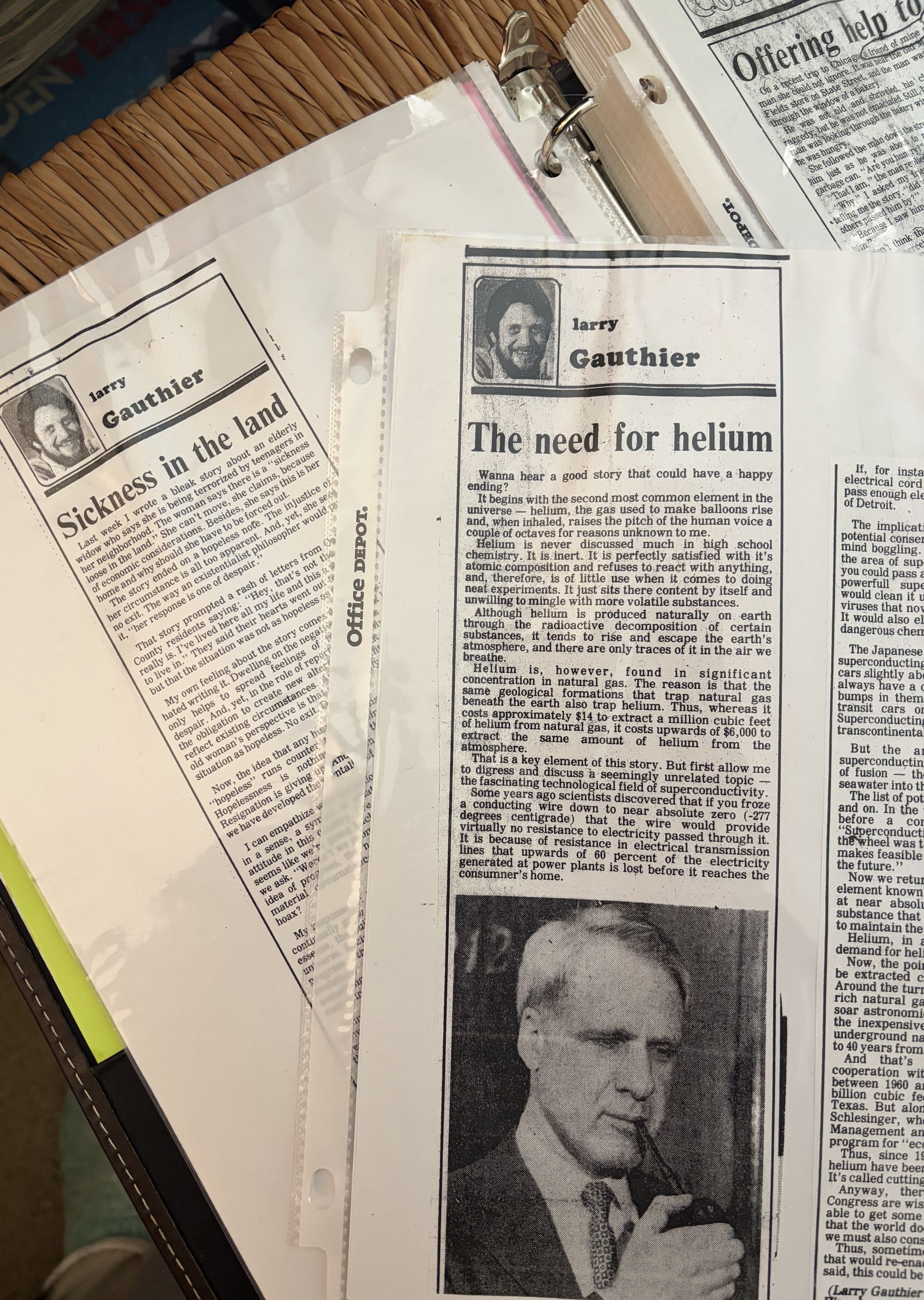
The Scrapbook
Our
Story
by
Lawrence Abby Gauthier
ace reporter
The Westphalia Periodic News
On my 78th Birthday
Part 1:
1979: The Five Paragraphs
The kids ask me what I'm planning to do for my 78th birthday. I tell them, we're at war, I'm going to work.
It's taken 78 years to get to where I am today. Things don't happen overnight... turn back the pages...
Leafing through a scrapbook of my old newspaper columns, I found what I was looking for. It was 1979. I was an investigative reporter and columnist at the Oakland Press in Pontiac, Michigan. Iranian revolutionaries had just taken 52 Americans hostage. I remembered that the column I was looking for had been entitled "Sickness in the Land." I remembered that the editors had wanted me to cut the final five paragraphs. We argued about it over beers and shots of cheap whiskey after work. It was my column, I argued, not news. It's where I was free to say what I think. They said I'd be called a conspiracy theorist, maybe a secret member of the Larouche "cult." I said I didn't give a shit. I threatened to quit. They ordered another round and the five paragraphs stayed. So, here's the five paragraphs that I wrote when I was 31 years old, 47 years ago...
(1) To put the whole thing in perspective, one only has to take a look at the ‘Project 80’s’ report recently released by the Council on Foreign Relations (CFR), a group formed in this country in 1919 as an adjunct to British Intelligence networks.
(2) The bottom line of this mammoth document is that the most critical problem facing the world during the coming decades is the gulf between the developed industrial nations and the so-called "Third World."
(3) The solution, according to this group of elites, is not to foster growth and progress throughout the world, but to begin bringing the industrial sectors down to Third World levels through a policy of "controlled disintegration."
(4) The method to be employed is a ‘return’ to outdated technological levels — biomass (or wood burning), coal gasification (the technology used by Hitler to fuel his war machine), windmills (like in a tulip field) and solar (the technology used by my mother to dry clothes on the backyard line).
(5) The excuse employed is the ‘energy crisis,’ coupled with the post Three Mile Island anti-nuclear hysteria. The consequences will not be the fiction of "energy independence," but bankruptcy and despair, evolving into a national consciousness that will accept anything, including wars like the planned invasion of the Persian Gulf region.
Part 2:
2026: The Punch Line
Culley Jane was upstairs at her computer working on the next chapter of her latest novel. I could hear her laughing. I called out: “Writing something funny?” She just laughed.
I think there’s no better feeling in the world than a good laugh. It was my birthday. I was suddenly 78 years old. To have made it this far after the way I’d lived my life seemed like a joke waiting for the punch line.
What I wanted for my birthday was to write something funny so everybody could have a good laugh.
But I couldn’t get myself into the mood.
I’ve been reading Michael Steinberger’s recent best seller, “THE PHILOSOPHER IN THE VALLEY.“
No, it’s not about my favorite philosopher, Leibniz. It’s about Palantir CEO Alex Karp, subtitled “the Rise of the Surveillance State.”
Right away I got to feeling like the the book would be about an unbalanced mind. The first chapter of the book about Alex Karp is entitled: “MAKING THE WORLD SAFE FOR HIMSELF.” Karp will become the archetype of all the Alex Karps of the world, lacking the ability to feel part of anything larger than themselves.
Kind of sad, you know.
In the language of Wikipedia: “Palantir Technologies, Inc. is an American publicly traded company that develops data integration and analytics platforms enabling government agencies, militaries, and corporations to make decisions by combining and analyzing data from multiple sources.”
Not very funny.
The way it works, the DOD, now the DOW, asks Palantir a question, like: “Given the givens, what’s the quickest, most efficient way to destroy Persia… the only way to bend it to our will, or at least our best bet to ger ‘er done? Forget about all that woke stuff about international law and our own rules of engagement. Disable the red lights. Just get us to where we want to go, quick like. Elections are just around the corner.”
Palantir's occult inert mind spits out an answer.
The DOW follows its orders like a cog in an autonomous machine.
According to former CIA analyst/IAEA weapons inspector Scott Ritter, Palantir most likely supplied the targeting data for World War Three’s opening attack… on a school for young girls in southern Iran, an algorithmically calculated act to spiritually and demographically demoralize and break the will a population to resist the inevitable, according to a tech company’s creation. The soldier on a ship at the end of a long chain of command passing down orders via Starlink doesn’t even have to think, just push a button and hope the Alex Karps of the world know what they’re doing and that it will all turn out for the best.
Not very funny at all, or satisfying.
Ironically, the State of Israel was born the same year I was born. That’s not funny, either. Kind of spooky, actually. But Leibniz said things are destined to be better because it’s possible and what’s possible demands to exist.
So a rabbi and a priest walk into a neighborhood bar. The muslim cleric behind the bar says, “What’ll it be?” They all laugh at one another’s off-color jokes.
In the bar's many dark, isolated corners sit the Alex Karps of the world, alone, but fed and safe, protected from the laughter coming from the other side of their imagined psychic walls.
But things don't happen overnight, so there's still lots of work to do on my birthday. Got a fire going in the fireplace. It's snowing outside. The snow is white and cold and melts into the ground.
--30--
The
Doctor's Couch
Dr. Jerry Gilbert
Clinical Psychologist
(Retired)
Denver

Dr. Jerry
In last week’s Thursday’s Columns, the ace reporter and Westphalia’s old Brooklyn Dodgers fan, Dr. Patrick Henry of Walla Walla, both raised the question of “why?” Why war? (BTW… Any relation to our own famous Revolutionary War-era hero?) (Editor’s reply… In the spirit, yes.)
When I think about “why,” I think of two definitions. One means “how”— how did we get from A to B? Or why did things turn out the way they did. In this sense, science focuses on “how” rather than “why.”
A second definition has to do with motivation. This “why” asks: what was the motive or purpose behind people’s actions? I think both of last week’s columns used “why” in this second sense.
War is an extreme example of many common examples of “why” people aren’t satisfied with “enough.” Each person or group decides what is enough for them, and that may not equate to what another person or group decides. Hitler had resurrected Germany from its humiliation during WWI. He encouraged the German people to feel good about themselves and he proposed false causes to bring about unity and even a sense of superiority. That may have been enough for the German people, but it wasn’t enough for Hitler. Hitler had personal reasons for pursuing “more than enough.” His larger goal was world domination, something other dictators pursued. That’s why empires are built.
Sometimes people steal because they actually don’t have enough. Poverty is rampant in many parts of our world. But many people steal when it isn’t “necessary” because they have “enough.” But they want more than enough. People engage in selfish, illogical, and even harmful behavior because that is how they feel good about themselves. This is more than the working of a meritocracy. It is common to human nature to possess things or people to (falsely) raise their self-esteem.
When a government tries to decide what is sufficient (which may or may not be enough) for people to thrive, it proves to be very complicated. Should it strive for something like Socialism or Communism which implements the slogan: “From each according to his ability, to each according to his needs.” Or “The needs of the many outweigh the needs of the few”? Even in a Democracy like the United States, the “why” of many behaviors involves the goal of power and protecting or adding to that power.
Socialism & Communism had positive ideas and goals which focused on equality and the needs of the many. But they are hard to sustain because something is missing. Almost every country based on Socialism or Communism morphed into something else. Socialist countries added Capitalism. Communist countries became dictatorships. The will to power is ubiquitous, from an individual to a country. That is a “why” that is hard to change because it is so ingrained in human nature.
There are many individuals, groups, and governments that try to make equality real. But is that enough? I think that “deserves” starts with acknowledging that we are all human beings and I believe that all human beings, for that reason alone, deserve respect, opportunity, education, and the basic health-kit which allows them to live safe and healthy. I think the lazy drunk deserves something (maybe many things), which is a combination of tangible and intangible goods and services. And that requires a government willing to establish and provide the resources needed, just because even the lazy drunk is human.
Jerry