Thursday's Columns
January 15, 2026
Our
Story
by
Lawrence Abby Gauthier
ace reporter
The Westphalia Periodic News
I’m trying to arrange an interview with University of Denver economics professor Dr. Francisco Rodriguez. We don’t live far from the DU campus. We could meet at a quiet coffee shop I know over there on the other side of I-25. My oldest daughter graduated from there with a degree in performance opera. So I’m familiar with the area, the paths through traffic, the lay of the land.
Dr. Rodriguez published a book last year called “The Collapse of Venezuela.” The first thing I did after learning that our bombs were falling was to get his book on Kindle, where he writes: “Between 2012 and 2020, Venezuela underwent the largest peacetime economic collapse in modern world history…” A nightmare.
A young Venezuelan family with a young son walked through treacherous, snake and gang-infested Central American jungles to escape the nightmare.
The young family is still hanging on, by fingernails and teeth, here, in America, trying to do everything right, but keeping an eye on the rear-view mirror. The father has work repairing old cars and delivering packages. They have a safe place to live. The boy is well behaved, in a good school and quickly learning a language he had never heard spoken before. One day he could learn calculus, too, and be the captain of a spaceship on its way to Mars. It doesn’t hurt a kid think that way.
With Culley Jane translating, I asked the father what he thought about what was going on. He said that maybe with Maduro out of the way it will be easier for them to go back to visit relatives they had to leave behind.
But you’d think there might have been a better way of going about it than going in like Rambo, guns blazing, shooting from high tech ships. It’s an election year here in America, where we have rights and laws. I expect that it might develop into a major campaign issue — Who gets to say it’s legal to kill people in another country? Big news. As a reporter, it’s my job to keep an eye on things like that.
But oh my Lord I know so little and reporters have to give the impression that they know what they’re talking about.
I’ve never been to Venezuela, or to any South American country. I don’t know their language. Culley Jane has taught me that people think differently in different languages. I was stumbling around, like lost in the woods.
Gramps and Dad always said the first thing you had to know to not get lost in the woods was the lay of the land. A GPS voice telling you where to turn at the next light is not giving you the lay of the land — maps do, though, like looking down from high above. I love maps. In the old days, truckers carried boxes of folded maps.
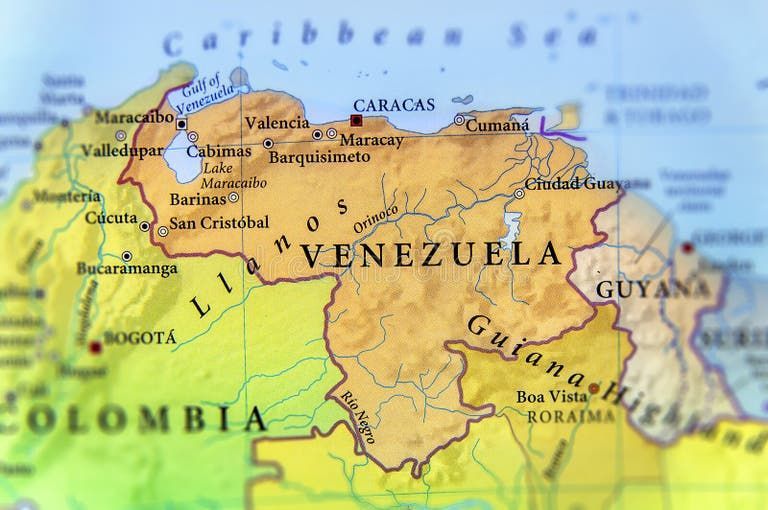
It was easy to find a map of Venezuela on the internet. I chose a colorful one, enlarged it on my computer screen, started a fire in the fireplace and then sat down to stare at the image, trying to get a feel for the lay of the land.
Maps are like Rorschach tests. Like mirrors, everybody sees something different in them, depending on their past, on who they are.
I had never before looked at Venezuela the way I was looking at it on my computer screen. It had always just been a small, unexamined area on the map of the world that hangs on my office wall.
What first caught my eye was the country’s northwest region, a watery basin, a navigable route connecting a land’s interior to the wider world... Names with a Latin rhythm — Lake Maracaibo to the Gulf of Venezuela and then on out into the Caribbean. I imagined that it had to be the watery passageway used by Spanish colonizers and pirates to get into the interior where there was silver and gold to finance Europe’s religious wars. Just five years after Columbus, by 1497, Spanish ships were seen in the Gulf of Venezuela. Amerigo Vespucci was aboard the first. Bloody battles were fought with people who had been living there for thousands of years. But the Spanish had a duty to conquer the world. Their sovereign was the Holy Roman Emperor, consecrated by the Pope to enlighten all the peoples, by force if necessary, and don’t forget the gold.
Not just conquistadors and native tribes were attracted, for different reasons, to the area. A long time ago, dinosaurs apparently were too. So the ground of the Maracaibo Basin is saturated with oil, seeping out of prehistoric graves. Until the 20th century, the mucky oil along the lake’s shores was just something everybody had to live with.
That’s when I saw myself in the map, when I got to thinking about the first real job I ever had, like where they take out taxes.
I was in high school. My girlfriend’s dad owned the Citgo Station in town. He gave me a part-time job taking care of customers who pulled in for gas — squeegee their windshields, check the oil, air cleaner and tires while the pump filled their tanks with Citgo gas.
Everybody knew that Citgo gas came from Venezuela, an exotic sounding place. Us younger guys thought it added a little zip to our cars, a little extra something that Texas “Standard” didn’t have. Latin rhythms were creeping into popular music. Hollywood was getting in on the act. Lots of us really thought that Citgo gas came from a place where all the women wore hats piled high with fruit. At the time, Venezuela had the fourth highest per-capita income in the world. The few bucks I got on my paycheck were just a tiny piece of the pie.
When the Arab oil embargoes of the 70s pushed oil prices sky high, Venezuela really boomed. There were stories (likely as apocryphal as the welfare queen’s pink Cadillac) about Venezuelan secretaries flying to New York just to buy jewelry, while Americans were waiting in long lines at the gas pump.
After that, I didn’t think much more about Venezuela until the young family happened into my life.
I reopened my eyes. The map came back into view. It was so obvious. Maracaibo, the path Europeans first took into the interior where they merged with tribes to become a people, just like in America, going up the Hudson, like I’m French-Canadien with relatives in Paris and in northern tribes.
I asked Culley Jane what the word Maracaibo meant. She looked it up. According to local legend, the tribal chieftain who was killed in the battles with the first Europeans was named “Mara.” She said “caibo” was closely related to the Spanish word for “fell.”
Mainstream news is focused on Caracas, the Capital, where politicians make the rules like castles of sand. But Caracas is not what caught my attention the day I went looking for the lay of the land.
--30--
The mind
Doctor
Dr. Jerry Gilbert
Clinical Psychologist
(Retired)
Dr. Jerry
(Editor’s Note: Since our ace reporter mentioned Rorschach tests in this week’s “Our Story” column, we decided to ask our favorite retired clinical psychologist to take a look at the thing before going to press. His reply :)
To the Ace Editor:
Well written with a good supply of history.
I remember Citgo, but nothing about Venezuela.
I suspect that Donald Trump also has a map of Venezuela with a dart sticking in it.
In fact, he probably has a map of the world with many darts sticking in many countries.
Perhaps he is writing a new version of Mein Kampf in which he plans world domination.
He probably liked to play "King of the Hill" as a child.
Like Hitler, he is aggressive and dares anyone to stop him from taking everyone's toys.
He is a danger to America and the world.
It may not be about anti-Semitism in particular, but it is a pursuit of "The Aryan Race" part 2.
Is the Emperor wearing any clothes?
Many people think they see a crown.
Jerry
New Paragraph