Thursday's Columns
January 29, 2026
Non-fiction
by
Terry Irwin
Denver Confluence Writers
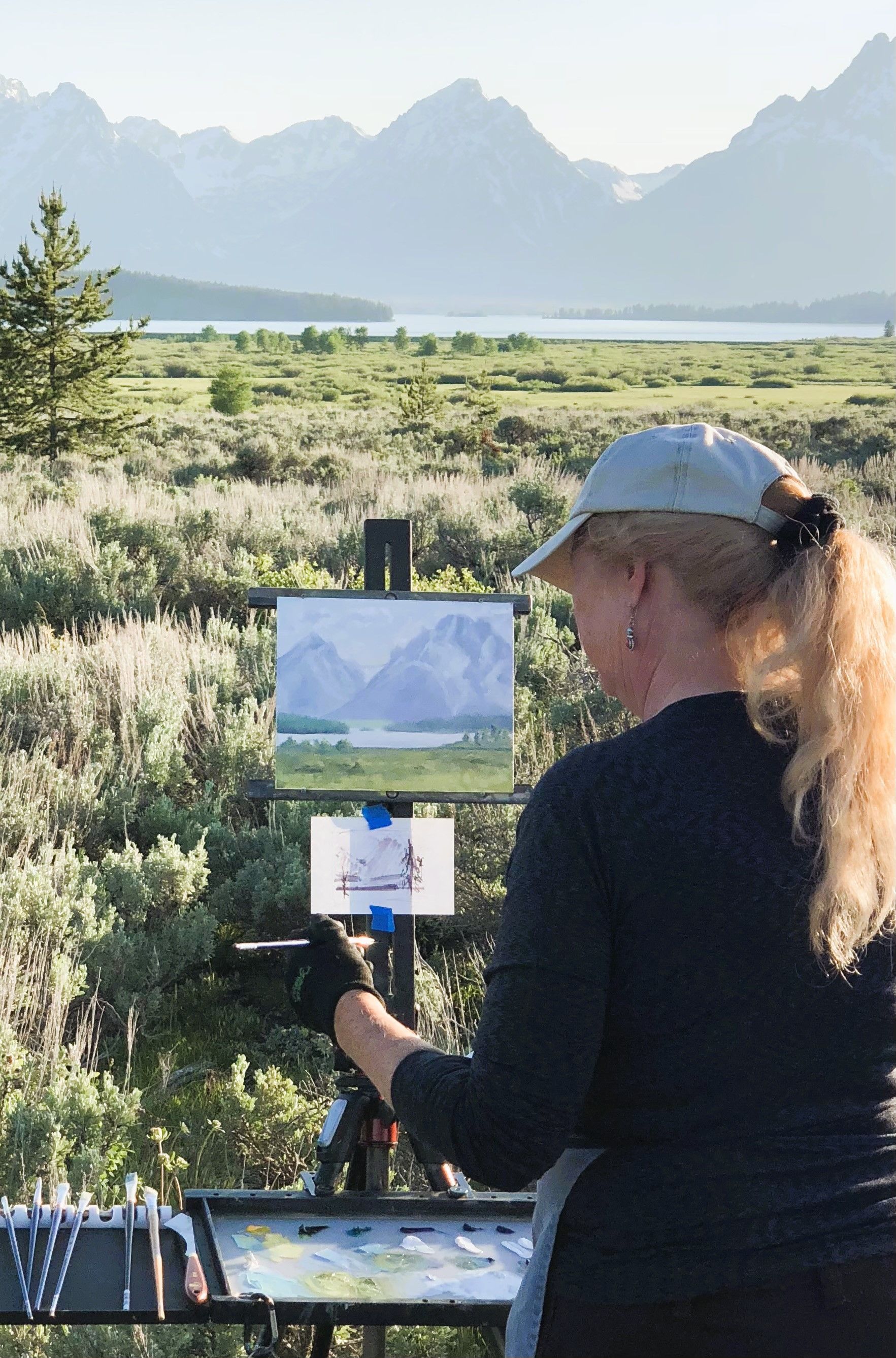
Terry Irwin sketching a mountain scene, photographed by her husband, John.
Hold On,
I'm Looking
Through Binoculars
One brisk morning, very early, John and I are not out on the mountain road for ten minutes when we notice eight cars parked on the right. Slowly, we pull over to the side of the road so that our left tires are up on pavement while the right tires are several inches lower on the gravel shoulder, tilting the entire truck at an angle.
From this side of the road, we can see what has attracted all the attention — two good-sized grizzlies in a sea of sagebrush scattered with neon yellow Mule’s Ear wildflowers.
John exits the truck, grabbing tripod and camera to stand outside while I’m happy with my perfect vantage point, our dogs napping in the backseat, fifty yards from the grizzlies, close enough to catch a few great shots with my phone.
And then it becomes a lot more interesting to watch them through my binoculars.
Estimating their weight around 250 lbs., these appear to be three-year-olds, sub-adults and probably siblings. Once a sow grizzly has raised her cubs, she chases them away to be on their own, then abandons the areas where she has weaned them. Sibling cubs may remain together for up to a year or more before heading off in their own directions, eventually becoming solitary creatures in adulthood. Seeing these bears, side-by-side like this, is a visual feast, inspiring images of nature in the raw that I long to capture on canvas.
More and more vehicles arrive and pull over. The crowd of cars, RVs, pickups and campers grows considerably in a short amount of time. Having parked either ahead of or behind us, people begin exiting their rides. Attempting to get closer for a better view, they gingerly maneuver the steep pitch, leaning their bodies inward towards the line of parked vehicles. People are mesmerized, eyes locked onto the bears, not watching where they step and more than a few almost bump their heads into the extended outside mirror of our truck.
A man, maybe in his forties, stops walking, stops directly in front of my open window, not aware I’m even there until he sees my binoculars protruding toward the meadow. Realizing he might be blocking my view, he abruptly squats down, shuffling a few inches back. Lowering my binoculars, our eyes meet when I nod in appreciation for his situational awareness. Since he has neither camera nor field glasses, I extend an invitation for him to look through mine.
He accepts. As he looks, his whispered claims of astonishment in seeing the bears so vividly makes me smile. There is so much awesomeness in this moment, there is no need for words… strangers in a shared experience.
A voice breaks the silence between us, nears, becoming louder, coming closer. A woman, his wife, is talking on her cell phone.
Sliding on the loose soil, she comes to stand next to him, still carrying on the phone conversation. The man looks over to me. With a wordless gesture he asks if I’d mind if his wife has a look-see through my glasses as well.
I nod, certainly.
He extends them to her as she says into the phone: ”Hold on a minute. I’m looking through binoculars.”
She brings them up to her eyes. Says nothing. Instead, there is a long silence as we watch the bears together.
I expected her to say: “WOW! I’m going to have to call you back. I’m looking at the most amazing sight... two large grizzly bears are right here in front of me.”
But nope, that’s not what she says.
Without a word, she hands the glasses back to her husband, turns away from the both of us and disappears towards the back of the truck. In the side mirror, I watch her walk toward their car, still making arrangements and future plans with somebody on a phone far away. Not once does she look over again at the grizzlies.
After she’s gone, the man returns to his own thoughts, seemingly humbled. He quietly tells me they are from Ohio and have never seen anything like this, two grizzlies in the wild. He seems genuinely awed and perhaps even reverent.
It saddened me to think how they'd missed an opportunity to savor this experience together, in shared joy, in amazement... a moment they might have relived in their lives back in the Midwest, sharing together in the telling of the grizzlies with the very person who had been at the other end of that cell phone call.
He thanks me profusely for the binoculars, then joins his wife in their car.
I try to grasp how this most extraordinary of chance encounters, this sibling grizzly sighting, had such an opposing effect; a reverence for one, a tolerated distraction for another.
--30--
Our
Story
by
Lawrence Abby Gauthier
ace reporter
The Westphalia Periodic News
I knew what it meant. It was the End of the World. How was I going to break the news to Culley Jane. It was late at night. She was already asleep upstairs.
The hardest part was knowing that it was my own damn fault. I should have kept my mouth shut — that time in Chicago in ’68, tear gassed protesting a foreign war; and all the things I said about Henry Kissinger and his Project 2000 scheme to de-industrialize America; and voting for Larouche; and last summer marching around the University of Colorado Anschutz Medical Center with my sign — NURSES AGAINST GENOCIDE.
As explained in the Big Book of Alcoholics Anonymous, my hubris was to blame; thinking I could know more than presidents with vast staffs of advisors with advanced degrees, pedigrees and titles. I could have stepped aside and trusted them to know what they were doing. But no. I had to open my big mouth. And now they have occult technologies. Even when I’m sleeping they can know and record my thoughts to be used against me in a secret trial. Like in a sci-fi thriller. The Twilight Zone. We’re walking together on the same city street, but live in different worlds and my world was about to end.
It started about twenty years ago. The headquarters of the trucking company I was working for was located in York, Nebraska, and so I decided to rent a room there for when I wasn’t on the road.
About 7,000 people lived in the town when I decided to get a room with an address there. York is on I-80, mile marker 353, in the eastern part of the state, a hundred miles from the Iowa border. It’s the county seat of a rich agricultural area. Most years there’s enough rain for dryland crops, but there’s also lots of center pivots tapped into the Ogallala aquifer and irrigation ditches diverting water from the nearby Platte.
For generations, the local farmers did their banking in York, borrowing for seed in the spring, paying off the notes after harvest in the fall. They were a team. The farmer had to know how to grow a crop. The banker had to know how to grow money… would a new steel plow more than pay for itself in the long run?
Back in the 80s, before I was a truck driver, back when I was running small town newspapers in Nebraska, I co-authored a book about the history of the western plains, how towns with fences and schools for kids were established where buffalo had recently roamed. Banks and bankers played a big role in the story.
And I needed a bank.
I needed a place where the company could deposit my paycheck and I could access it at ATM’s in truck stops around the country. Truckers had to have cash, especially at the Jersey docks where a twenty helps get you unloaded in time to beat the evening rush.
The bank was just a couple blocks from the old downtown hotel where I had my room. I was obviously a new face in town, but I guess because I worked for Crete Carriers, a major employer thereabouts, I was treated like a local.
The lady at the reception desk in the bank lobby was wearing a brightly colored polka dot dress.
“I work at Crete and I need to open a bank account,” I told her.
“Oh, my husband works at Crete,” she said. “Frank. Night dispatch. Lots of our customers work at Crete. I went to school with the founder’s daughter. Frank did too.” She said her name was Shirley.
I said to her: “So you’re married to Frank the night dispatcher, the guy who bails me out when I get into trouble somewhere out there on the road at night.”
“That’s Frank, all right,” she said. “I think you’ll like it here in York. People look out for one another. Safe to walk the streets.” I noticed her glance at my hand. “Mmm,” she said with a wink, “no ring, I see.”
Ushering me into the small office of a young banker to do my business, she introduced me as “a new local in town.”
The young banker had grown up on a local farm before studying economics at the University of Nebraska. He’d been a defensive tackle on the York High School football team when Shirley’s future husband, Frank, was the quarterback and they’d won the conference championship. Shirley had been a cheerleader.
After signing the necessary papers, the young banker shook my hand. “Welcome to the family,” he said. “If you ever need help with anything, any problems, just give us a call.”
And now that’s what I’ve been doing for over twenty years. Whenever I’ve had a banking problem or question (like when I was robbed in a Texas parking lot and my wallet was stolen and I didn’t know what to do, or how was I supposed to get money if I went to Europe) I’d call Cornerstone Bank and a real person would answer the phone. No complicated prompt-response maze to negotiate to get to a voice in Bangladesh with instructions in a language that was hard for me to understand. As long as it was during working hours, at Cornerstone Bank a real person always answered the phone. That’s why I’ve remained a loyal Cornerstone customer for over twenty years now.
Until a few years ago when she retired, it was often Shirley who answered the phone and we’d chat before she transferred me to somebody who could answer my banking question. She told me all about the young person who would be taking her place. She said that Frank and her were thinking about moving to Arizona.
Just like in the beginning, I still have my paycheck deposited directly into my Cornerstone account. Now it’s my Social Security check.
It was late at night. I was watching internet videos about the latest Minneapolis shooting. I imagined the sound of Lake Superior ice breaking up in a storm. Over the years, I had picked up many loads at the 3M and Pillsbury plants there. Minneapolis winters can be rough going. I have an aunt and cousins there. The protestors are wearing heavy winter coats. That made me think about security.
And then I got to thinking about Social Security.
The program’s initial champion back in the 30s had been a woman, Francis Perkins, FDR’s choice to head his administration’s Department of Labor.
My January check should have just arrived in my Cornerstone account. I wondered what it would be with the new cost-of-living adjustment applied.
I’m not a complete computer illiterate. I know how to access my Cornerstone account on-line. I’ve been doing it for years.
A couple clicks got me to the Cornerstone log-in. A couple more brought up a big red warning sign: ACCESS DENIED! I tried again. ACCESS DENIED! Like how dare me to even try.
I’d been de-banked! I wasn’t just being paranoid. It had been happening to others who thought they knew better than a president with a vast staff of advisors. Those Canadian truckers who’d snarled up the country protesting something or other a couple years back had been de-banked. I hear Scott Ritter recently got de-banked too and what about that My Pillow guy? Whole countries get de-banked and the Nightly News calls it “sanctions,” like just by using a word related to the word “sanctify” is somehow supposed to make it right.
I felt abandoned. A social animal abandoned by the tribe. Rousseau’s noble savage, alone in the woods, losing language, hunting for food.
I had a hard time falling asleep. I would have to tell Culley Jane about it in the morning. If they were doing it to me, they could do it to her, too. At least I knew I could talk to somebody at the bank in the morning… maybe. Even Cornerstone is one small cog in a much larger money machine, transcending artificial borders.
Before calling the bank the next morning, I tried logging into the account one last time. Got right in! No problem. Everything was up to snuff. I was even getting a little more in my Social Security check, nothing like the rising cost of meat, but not nothing either. I must have forgotten the pound sign in my password the night before, distracted by the Minnesota videos.
What a relief. We weren’t de-banked. We could still buy groceries with a debit card at King Soopers. Nobody’s after me. I’m unimportant. I have Constitutional protections…
I was just being paranoid, that’s all.
Right?
Nevertheless, I decided to be a little more careful in the future about how I say what I say out loud in a crowded room. Say "smoke" when it looks like FIRE!
Was being a little more careful a price too high to pay to avoid the clubs and gas on the street. After all, I’m not always right. I thought I’d been de-banked. I thought it was the end of the world.